Fruit Enzyme Supplier for Juice Clarification: Formulation and Processing Guide
Source fruit enzymes for juice clarification with practical pH, temperature, dosage, QC, pilot validation, and supplier qualification guidance.
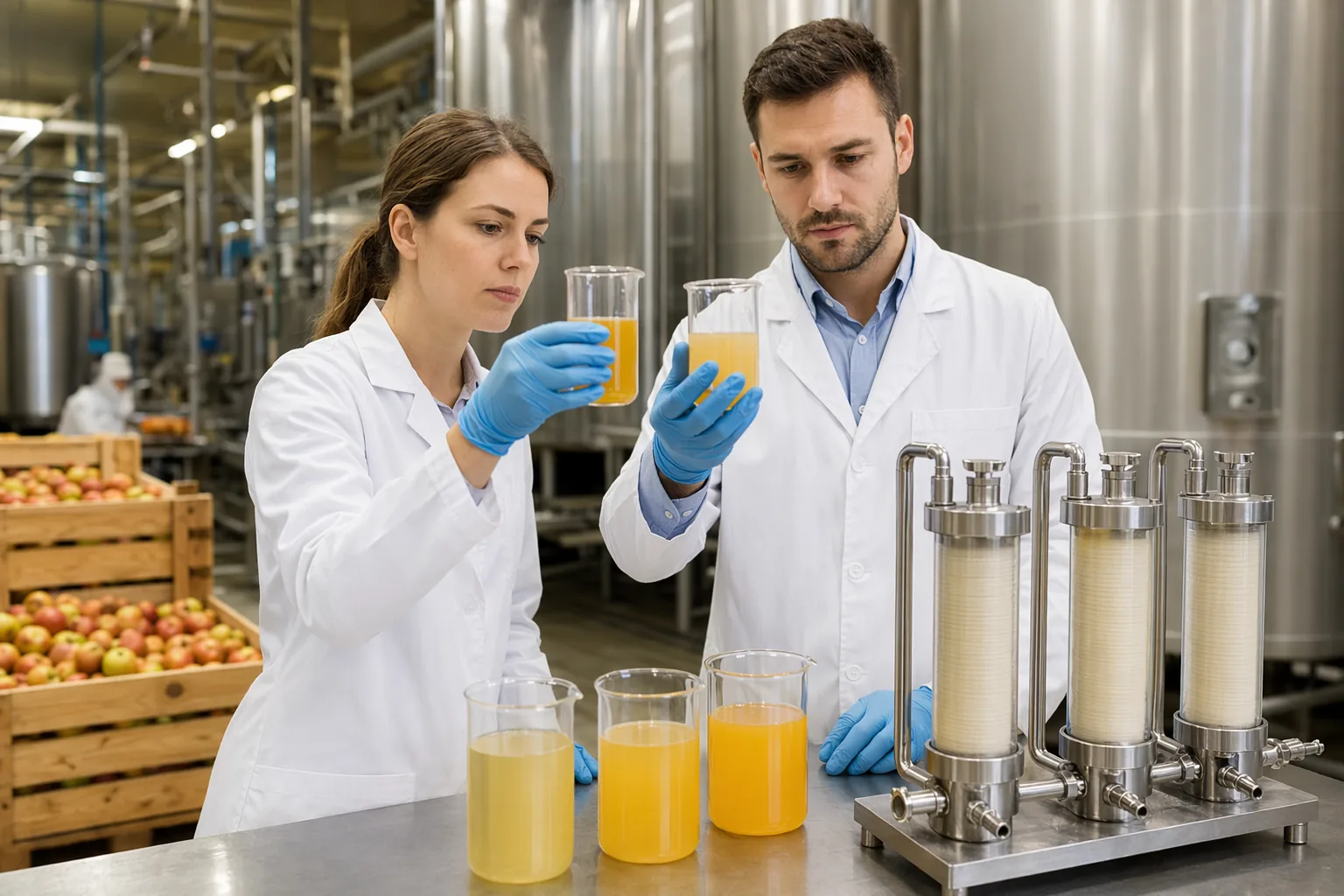
For juice, wine, and fruit processing plants, the right enzyme system can improve clarification, reduce viscosity, support filtration, and make downstream separation more predictable.
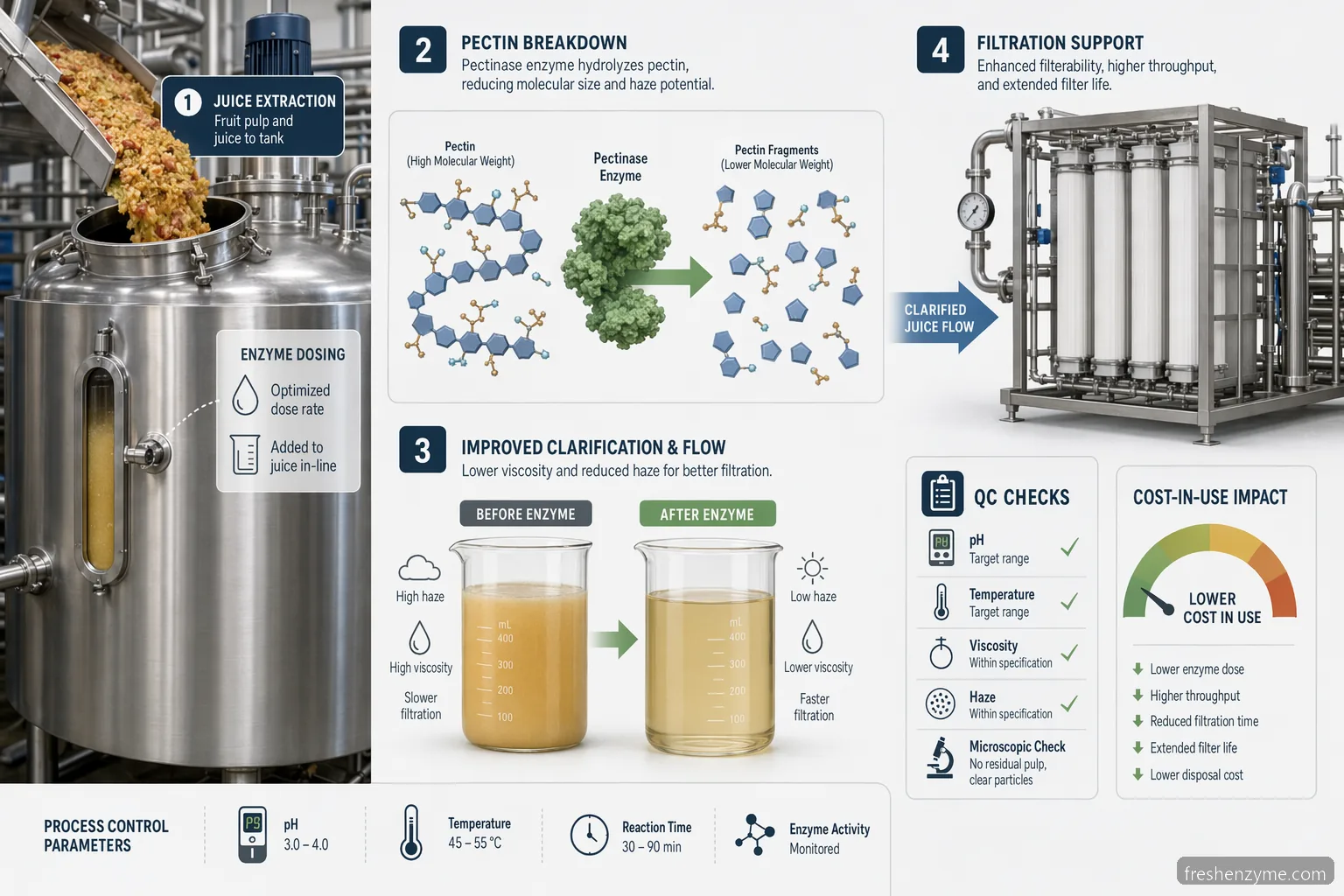
Role of Fruit Enzymes in Juice Clarification
A fruit enzyme for juice clarification is normally a pectinase-rich preparation used to break down soluble and insoluble pectin networks in crushed fruit, mash, juice, or must. In industrial fruit processing, pectin can hold haze particles in suspension, increase viscosity, slow pressing, and limit filtration throughput. A suitable juice clarification enzyme reduces these barriers by degrading pectin and, when formulated with supporting side activities, can also help release entrapped liquid from pulp. For a B2B processor, the goal is not simply a clear beverage; it is a repeatable clarification step that fits existing tanks, residence time, temperature control, separators, and filters. Fresh Enzyme supports buyers evaluating an industrial fruit enzyme juice clarification program for apple, pear, berry, grape, tropical fruit, and blended juice lines. The enzyme should be selected against actual raw material variability, not only a brochure dosage, because cultivar, ripeness, pulp load, and heat history can significantly change performance.
Supports haze reduction and lower viscosity • Improves pressing, settling, centrifugation, or filtration behavior • Useful in juice clarification, wine, and broader fruit processing • Requires validation on the buyer's real juice matrix
Selecting a Juice Clarification Enzyme System
A juice clarification enzyme supplier for fruit processing should help match enzyme activity to the specific substrate challenge. Pectinase juice formulations may include polygalacturonase, pectin lyase, pectin methylesterase, arabinase, cellulase, or hemicellulase activities, depending on whether the target is depectinization, mash maceration, viscosity reduction, or filterability. Clear apple juice, berry juice, citrus blends, and grape must can require different activity balances. For wine, the supplier should also consider phenolic extraction, color stability, aroma impact, and the lower temperature conditions often used during maceration or settling. Ask for a Technical Data Sheet that defines recommended application point, activity basis, pH and temperature range, inactivation options, and storage conditions. A good juice clarification enzyme supplier for wine or juice clarification should be able to explain why a liquid or powder format is appropriate and how the product behaves in your equipment.
Review the enzyme activity profile, not only the product name • Confirm suitability for juice, wine, or mash-stage fruit processing • Compare liquid versus powder handling and dosing accuracy • Check whether the TDS includes practical process limits
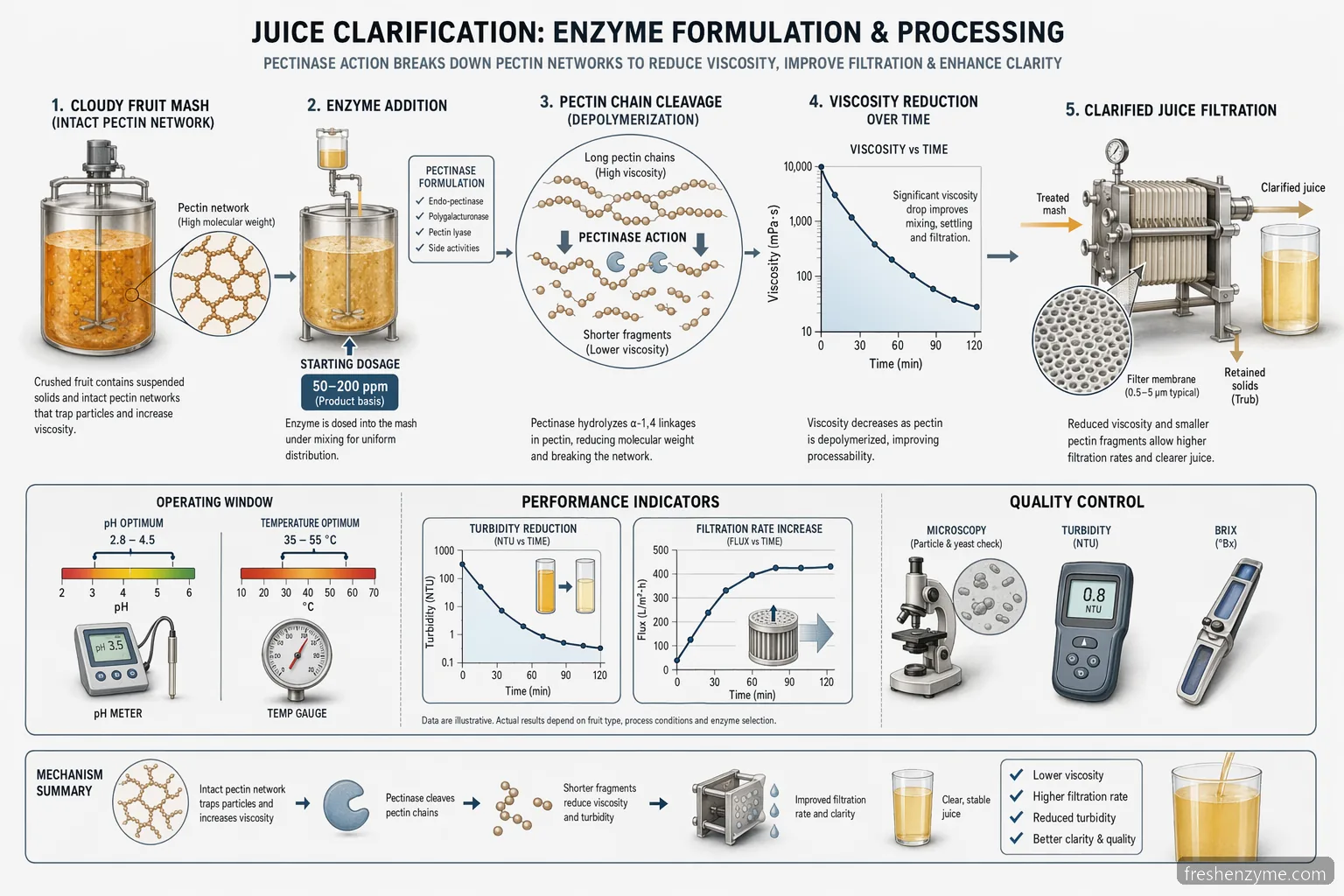
Practical Process Conditions and Starting Dosage
Initial formulation trials commonly evaluate pH 3.0-5.0, temperatures of 35-55°C, and contact times of 30-120 minutes for many juice clarification applications. Wine and cold-processing operations may run at lower temperatures, often requiring longer contact time or adjusted dosage. A practical starting band for a juice clarification enzyme is often 20-150 g or mL per metric ton of mash or juice, depending on enzyme activity, fruit type, solids level, and desired processing speed. High-pectin fruits, heat-treated pulp, or short residence time may require a higher dose, while low-pectin juice may need less. The dosage should be confirmed by a pectin test, turbidity trend, viscosity measurement, and filtration response rather than appearance alone. Avoid changing temperature, dose, and time simultaneously during trials; a structured design makes scale-up decisions easier and improves cost-in-use calculations.
Typical pH screening: 3.0-5.0 • Typical temperature screening: 35-55°C • Common trial dosage: 20-150 g or mL per metric ton • Validate with pectin, turbidity, viscosity, and filtration data
Pilot Validation and Quality Control Checks
Before plant adoption, an industrial juice clarification enzyme fruit processing trial should move from bench screening to a pilot or production-side validation. Use representative fruit lots, normal sanitation practices, standard pumps, actual holding tanks, and the intended downstream separator or filter. Key QC checks include residual pectin test, turbidity or NTU, viscosity, Brix, pH, color, sediment volume, filter flux, press yield, and sensory review where relevant. For wine, also monitor color extraction, clarification speed, and any impact on varietal character. Record enzyme lot number, dose, addition point, mixing time, juice temperature, contact time, and inactivation or separation step. The best result is a process window, not a single data point. A qualified fruit enzyme supplier for juice clarification should help interpret results and recommend a robust operating range that tolerates seasonal raw material variation.
Run bench, pilot, and plant confirmation stages • Measure clarification performance and downstream throughput • Track lot number, dose, temperature, pH, and time • Define an operating window for seasonal variation
Supplier Qualification and Cost-in-Use
For procurement teams, the lowest unit price may not deliver the best economics. Cost-in-use should include enzyme dosage, juice yield, filtration rate, downtime, waste solids, rework risk, storage stability, and labor needed for preparation or dosing. A juice clarification enzyme supplier for juice clarification should provide a current Certificate of Analysis, Technical Data Sheet, Safety Data Sheet, allergen or regulatory statements where applicable, lot traceability, and a defined shelf life. Buyers should also assess packaging integrity, lead time, batch consistency, technical response time, sample availability, and change-control communication. Supplier qualification can include document review, sample testing, pilot validation, and periodic incoming QC. Fresh Enzyme works with processors that need an industrial fruit enzyme juice clarification option supported by documentation, application guidance, and trial planning for juice, wine, and fruit processing lines.
Request COA, TDS, SDS, shelf life, and traceability • Calculate cost-in-use, not only price per kilogram or liter • Confirm batch consistency through incoming QC • Include technical support in supplier qualification
Technical Buying Checklist
Buyer Questions
Pectinase is the most common juice clarification enzyme because pectin is a major cause of viscosity, haze stability, slow settling, and poor filtration in many fruit juices. Commercial products may combine several pectinolytic activities with supporting cellulase or hemicellulase activities. The best choice depends on fruit type, process stage, pH, temperature, pulp load, and whether the goal is settling, pressing, filtration, or wine clarification.
Start with the supplier's TDS, then run a small matrix around realistic process conditions. Many industrial trials screen about 20-150 g or mL per metric ton, with pH 3.0-5.0 and 35-55°C where suitable for the juice. Measure residual pectin, turbidity, viscosity, and filterability. The correct dosage is the lowest level that consistently meets clarification and throughput targets.
Sometimes, but it should be validated separately. A juice clarification enzyme supplier for wine should consider lower processing temperatures, contact time, grape variety, phenolic extraction, color, aroma, and lees behavior. Juice applications may focus more heavily on pectin reduction, pressing yield, and filtration speed. Use pilot testing to confirm that one product can meet both technical and sensory requirements.
A qualified supplier should provide a Certificate of Analysis, Technical Data Sheet, Safety Data Sheet, lot number, shelf-life and storage guidance, and relevant product statements for the buyer's market. The COA supports incoming quality checks, the TDS guides application conditions, and the SDS supports safe handling. For repeat purchasing, also request change-control communication and batch consistency information.
Calculate enzyme cost per ton of fruit or juice, then compare the operational impact. Include yield improvement, shorter settling time, higher filter flux, lower filter aid use, reduced tank occupancy, fewer rework batches, and waste handling changes. A higher-priced enzyme may be more economical if it works at a lower dose or improves downstream throughput. Pilot data is the best basis for the calculation.
Related Search Themes
juice clarification enzyme supplier for fruit processing, juice clarification enzyme supplier for wine, juice clarification enzyme supplier for juice clarification, juice clarification enzyme for fruit processing, industrial juice clarification enzyme fruit processing, industrial fruit enzyme juice clarification
Juice Clarification Enzymes for Research & Industry
Need Juice Clarification Enzymes for your lab or production process?
ISO 9001 certified · Food-grade & research-grade · Ships to 80+ countries
Frequently Asked Questions
What type of enzyme is most common for juice clarification?
Pectinase is the most common juice clarification enzyme because pectin is a major cause of viscosity, haze stability, slow settling, and poor filtration in many fruit juices. Commercial products may combine several pectinolytic activities with supporting cellulase or hemicellulase activities. The best choice depends on fruit type, process stage, pH, temperature, pulp load, and whether the goal is settling, pressing, filtration, or wine clarification.
How should we set the first trial dosage?
Start with the supplier's TDS, then run a small matrix around realistic process conditions. Many industrial trials screen about 20-150 g or mL per metric ton, with pH 3.0-5.0 and 35-55°C where suitable for the juice. Measure residual pectin, turbidity, viscosity, and filterability. The correct dosage is the lowest level that consistently meets clarification and throughput targets.
Can the same enzyme be used for juice and wine?
Sometimes, but it should be validated separately. A juice clarification enzyme supplier for wine should consider lower processing temperatures, contact time, grape variety, phenolic extraction, color, aroma, and lees behavior. Juice applications may focus more heavily on pectin reduction, pressing yield, and filtration speed. Use pilot testing to confirm that one product can meet both technical and sensory requirements.
What documents should an industrial enzyme supplier provide?
A qualified supplier should provide a Certificate of Analysis, Technical Data Sheet, Safety Data Sheet, lot number, shelf-life and storage guidance, and relevant product statements for the buyer's market. The COA supports incoming quality checks, the TDS guides application conditions, and the SDS supports safe handling. For repeat purchasing, also request change-control communication and batch consistency information.
How do we calculate cost-in-use for clarification enzymes?
Calculate enzyme cost per ton of fruit or juice, then compare the operational impact. Include yield improvement, shorter settling time, higher filter flux, lower filter aid use, reduced tank occupancy, fewer rework batches, and waste handling changes. A higher-priced enzyme may be more economical if it works at a lower dose or improves downstream throughput. Pilot data is the best basis for the calculation.
Related: Clearer Fruit Juices with Faster Separation
Turn This Guide Into a Supplier Brief Request a Fresh Enzyme sample, TDS, COA, SDS, and pilot trial plan for your juice clarification process. See our application page for Clearer Fruit Juices with Faster Separation at /applications/fruit-juice-clarification/ for specs, MOQ, and a free 50 g sample.
Contact Us to Contribute