Enzyme Mash Treatment: Pressing Yield and Viscosity Control in Fruit and Concentrate Lines
Plant process guide for fruit, cider and concentrate lines: mash treatment for pressing yield, viscosity control, QC checks, COA/TDS/SDS, pilot trials and supplier selection.
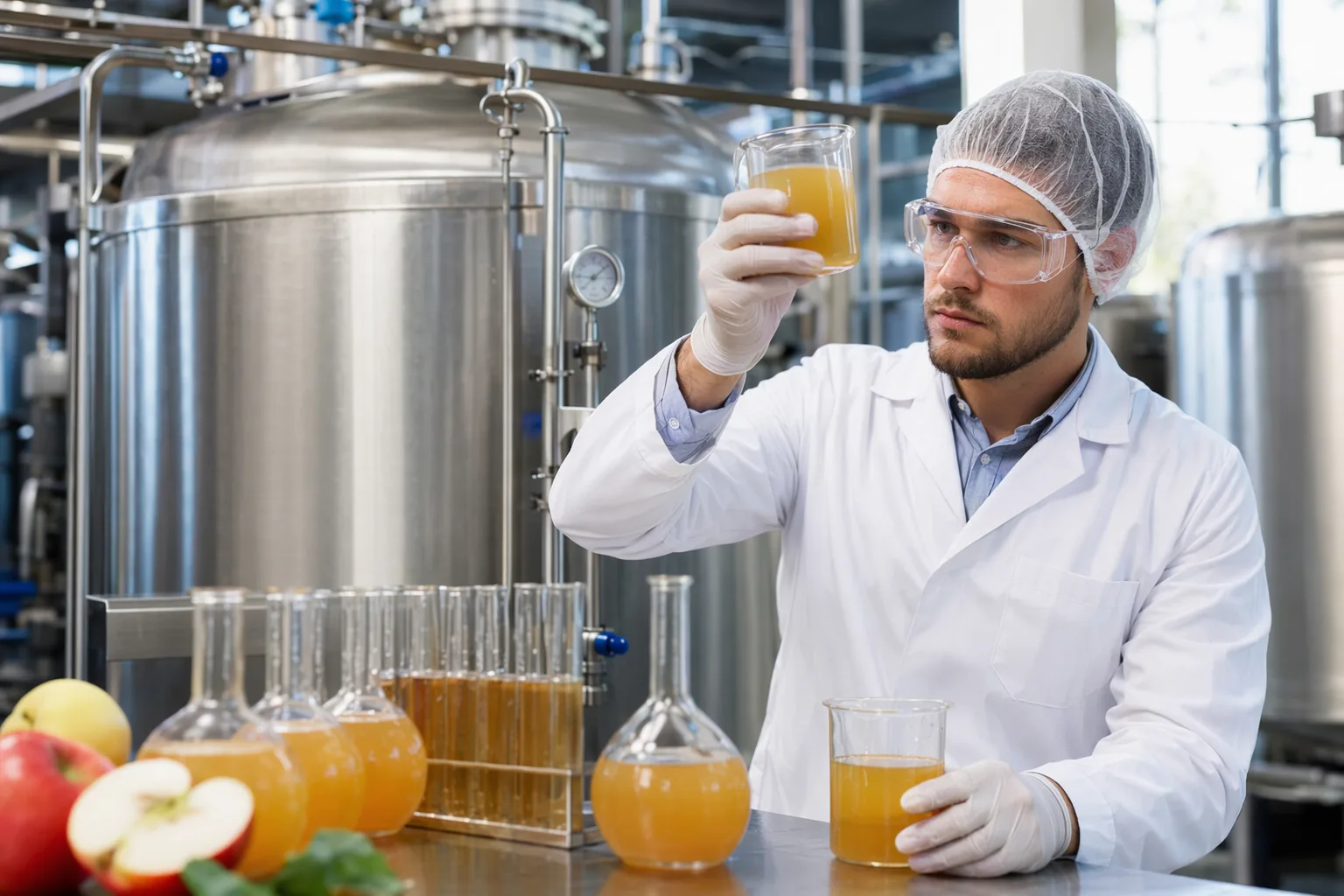
For fruit processors, cideries, wineries and concentrate plants: where a pectin-degrading enzyme goes in the line to raise pressing yield and bring viscosity down before separation and concentration, how to set trial conditions, which QC checks prove it works, and how to compare bulk suppliers on cost-in-use.
To request a quote, send the product (liquid or powder), the quantity, the destination and your process step to hello@mail.freshenzyme.com or through the inquiry form. Packs are 25 kg drums, 200 L barrels or custom packaging; the minimum order is 25 kg; pricing and freight are quoted per order.
Why pectinase is used in industrial juice clarification
In fruit processing, pectin naturally stabilizes cloud, increases viscosity, and can slow separation, pressing, centrifugation, and filtration. A juice clarification enzyme based on pectinase hydrolyzes pectic substances into smaller fragments, helping suspended solids settle or separate more predictably. For an industrial clarification program, the goal is not simply a brighter liquid; it is a controlled process that supports throughput, yield, and repeatable quality. Pectinase is commonly applied to apple, pear, berry, stone fruit, grape, and mixed fruit streams, with performance depending on fruit variety, maturity, mash treatment, soluble solids, pH, temperature, and holding time. In wine, pectinase can support must clarification and pressing efficiency, while in juice clarification it is often integrated before fining, centrifugation, ultrafiltration, or polishing filtration. Selection should be based on substrate fit, activity profile, and plant economics.
Reduces pectin-related viscosity and haze formation • Supports sedimentation, centrifugation, or membrane filtration • Can improve pressing and clarification consistency • Requires validation for each fruit matrix and process line
Recommended process conditions for application trials
Our juice clarification enzyme is specified for pH 3.5–5.5 and 40–55 °C, which fits warm clarification of many acidic juices; cooler winery or premium juice processes need longer contact time. The trial dose comes from the TDS and depends on declared activity, fruit pectin load, turbidity target and residence time, and contact time is set in the same trial. Avoid excessive heat, aggressive sanitation carryover, or incompatible preservatives during dosing, as these may reduce enzyme activity. Always confirm the supplier’s TDS for specific limits.
Stated working range: pH 3.5–5.5 and 40–55 °C • Cold processes may require longer contact time • Start dosage trials across low, medium, and high bands
Where to Dose: Mash, Juice or Must
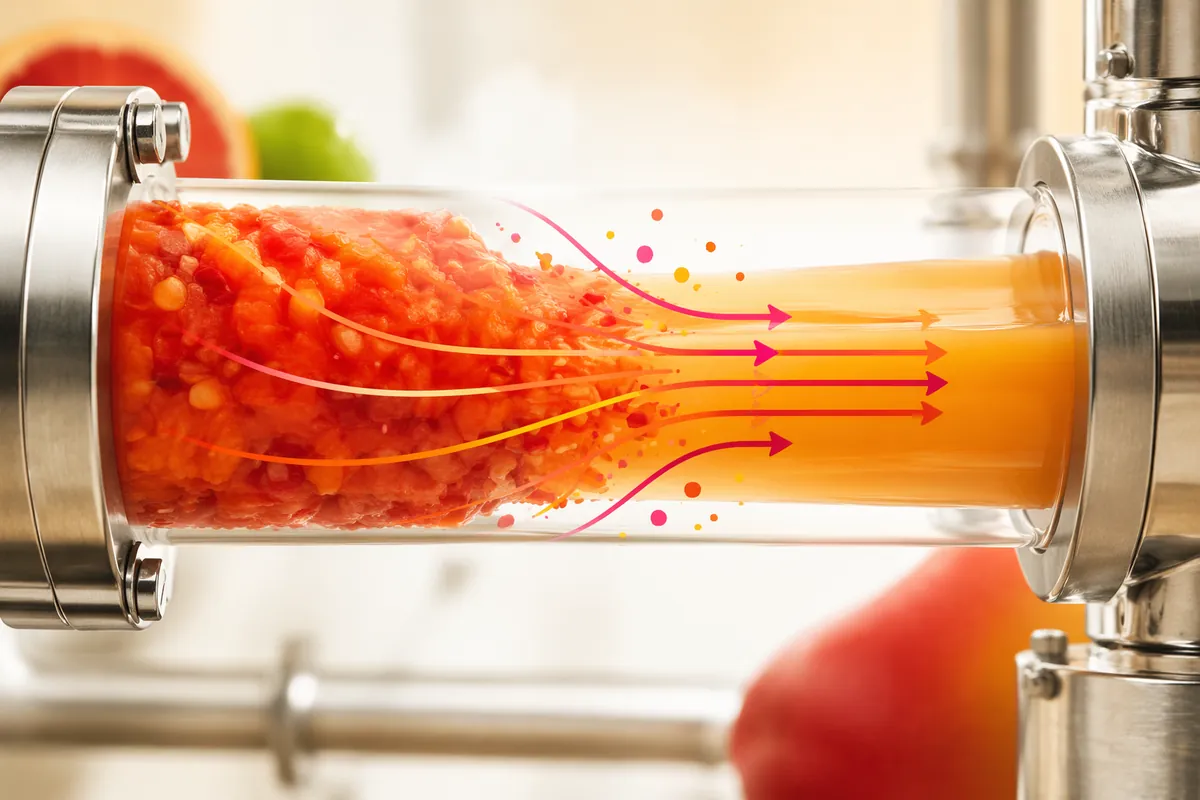
The enzyme can be added to crushed fruit mash, pressed juice, must, or intermediate juice before filtration. Mash treatment may improve juice release and pressing efficiency, while juice treatment is often used to reduce haze and improve final filtration. In fruit processing, formulation teams should consider pulp content, soluble solids, native polyphenols, calcium level, and the amount of heat already applied to the fruit. Overprocessing can be wasteful, while underdosing may leave residual pectin that blocks membranes or causes haze failures. The supplier should provide guidance on dilution, dosing pumps, mixing time, and compatibility with preservatives, fining aids, or filtration aids. If enzymes are used before thermal pasteurization or concentration, the heat step may also serve as an inactivation point, subject to product-specific validation.
Add before the bottleneck step: pressing, settling, flotation, centrifugation, or filtration. • Confirm compatibility with fining agents, preservatives, and heat treatments. • Use plant trials to balance clarity, yield, throughput, and sensory requirements.
Application Fit: Juice, Wine, and Fruit Processing
The same category of juice processing enzyme may be used differently across juice clarification, wine, and fruit processing lines. In pressed apple or pear juice, the priority is often rapid depectinization, press yield, lower filter load, and bright clarity. In grape must and wine, the focus may include settling speed, lees compaction, color management, and avoiding over-extraction from skins or seeds. For berry and tropical fruit processing, higher pulp content, anthocyanins, proteins, or starch-like haze contributors may require a blended enzyme approach or additional fining validation. Buyers should compare application data rather than only headline activity units, and evaluate each option under the same plant conditions used for commercial production.
Apple and pear: depectinization, yield, filtration • Grape and wine: settling, lees compaction, clarity • Berry: pulp handling and color-sensitive validation • Tropical fruit: viscosity reduction and separation support
Wine and Premium Juice Considerations
For wine and premium juice, processors should pay attention to temperature, contact time, varietal character, and the desired level of clarification before fermentation or stabilization. In wineries, a clarification enzyme is commonly used for grape must settling, press fraction handling, and clarification of difficult juices. Cooler cellar temperatures slow enzyme action, so lower-temperature processes usually need a longer contact time or a product designed for cold performance. For premium juice and wine, aggressive treatment is not always desirable; the best result is usually the minimum validated dose that achieves filterability and turbidity goals without unnecessary processing. The supplier should support small-scale trials across grape varieties, harvest conditions, and turbidity targets, especially when pectin content varies because of maturity, mechanical harvesting, or skin contact.
Cool processes may require longer contact times. • Validate dose by varietal, harvest condition, and clarification target. • Use sensory checks alongside turbidity and filterability tests.
How to run a pilot validation before plant adoption
A supplier should support structured bench and pilot testing rather than recommending a fixed dose without context. Begin with untreated control samples and at least three enzyme dosage levels under the same pH, temperature, and holding time. Measure viscosity reduction, turbidity, settling rate, juice yield, filterability, color change, soluble solids, acidity, and sensory impact where relevant. Filtration tests are particularly important because a visually clear juice may still block membranes or sheets if colloids remain. Scale from laboratory jars to pilot tanks before full production, and verify mixing, dosing point, holding time, and enzyme deactivation or downstream compatibility. Record the economic result as cost-in-use per metric ton, not only enzyme price per kilogram.
Include an untreated control for every trial • Test multiple doses under identical conditions • Measure filterability, not only turbidity • Calculate cost-in-use before commercial approval
QC checks and documentation buyers should request
Industrial buyers should qualify any fruit enzyme supplier through documentation and lot-to-lot performance review. Request the certificate of analysis, technical data sheet, safety data sheet, activity definition and test method, recommended storage conditions, shelf life, production lot traceability, and handling guidance. For pectinase juice for juice clarification, the COA should confirm the relevant enzyme activity and basic quality parameters agreed in the purchase specification. The TDS should define application conditions, dosage guidance, compatibility notes, and any heat or pH sensitivity. The SDS supports safe handling and plant training. In addition, ask whether the supplier can provide pilot samples, retain samples, batch records upon agreement, and change notification procedures. Avoid relying on undocumented claims, especially when comparing industrial pectinase juice wine and juice clarification applications that may require different activity profiles.
COA: lot-specific activity and agreed quality checks • TDS: dosage, process window, storage, and compatibility • SDS: safe handling and workplace precautions • Traceability: lot number, shelf life, and change control
Supplier selection and cost-in-use considerations
A reliable bulk supplier should help processors balance performance, documentation, supply stability, and economics. Price per kilogram is only one part of the purchasing decision. A higher-activity enzyme may reduce dosage, shorten holding time, increase filtration throughput, reduce clarifier load, or improve juice recovery, leading to a lower cost-in-use. Buyers should compare products using the same fruit lot, same process conditions, and the same quality endpoint. Supplier qualification should also review lead time, packaging formats, storage requirements, technical support, sample availability, and responsiveness to nonconformance investigations. The best product is the one that delivers stable results at commercial scale without creating downstream issues in fining, filtration, blending, concentration, or packaging.
Compare cost per treated ton, not only unit price • Verify supply continuity and packaging suitability • Assess technical support for troubleshooting • Confirm performance under commercial line conditions
What to Send With a Quote Request
A quote request that contains the following gets a usable answer in one reply instead of several rounds of questions. Distributors and resellers can send the same details for their end customer's application.
Product form: liquid or powder, and the activity range you work with. • Quantity: first order and expected monthly or annual volume. • Destination: country and port or delivery city, so freight can be quoted. • Process: fruit or must, treatment point (mash, juice or must), temperature, pH and holding time. • Documents your QA team needs to review before approval. • Pack preference: 25 kg drums, 200 L barrels or custom.
Buyer Questions
Pectinase breaks down pectic substances that stabilize haze and increase viscosity in fruit juices and wine must. By reducing pectin-related colloids, it can improve settling, centrifugation, filtration, and visual clarity. The result depends on fruit type, pH, temperature, enzyme activity, dose, and contact time. Commercial use should always be validated with the processor’s actual raw material and equipment.
The correct dose depends on enzyme activity, formulation, fruit pectin level, process temperature, residence time, and the required clarity or filterability target. Ask the supplier for the TDS and run low, medium, and high dosage trials against an untreated control.
Sometimes, but performance should not be assumed. Wine applications may differ from juice in temperature, contact time, turbidity target, alcohol exposure, sulfur dioxide use, and sensory requirements. A product that performs well in apple juice may not be optimal for grape must or berry processing. Request application-specific guidance and confirm results through pilot validation.
Buyers should request a COA, TDS, SDS, enzyme activity definition, test method, shelf-life information, storage recommendations, and lot traceability. The COA confirms lot-specific quality data, the TDS guides application conditions, and the SDS supports safe handling. For supplier qualification, also ask about pilot sample availability, change notification, complaint handling, and technical support.
Cost-in-use should include enzyme dosage, price, treated volume, contact time, yield improvement, filtration throughput, energy demand, clarification aid reduction, labor impact, and any reduction in rework or batch delays. Comparing only price per kilogram can be misleading because enzyme activity and process benefits vary. Evaluate competing products under the same fruit lot and production conditions.
Juice Clarification Enzymes for Research & Industry
Need Juice Clarification Enzymes for your lab or production process?
ISO 9001 certified · Food-grade & research-grade · Ships to 80+ countries
Frequently Asked Questions
What is the main function of pectinase in juice clarification?
Pectinase breaks down pectic substances that stabilize haze and increase viscosity in fruit juices and wine must. By reducing pectin-related colloids, it can improve settling, centrifugation, filtration, and visual clarity. The result depends on fruit type, pH, temperature, enzyme activity, dose, and contact time. Commercial use should always be validated with the processor’s actual raw material and equipment.
What dosage should a processor use for pectinase juice clarification?
The correct dose depends on enzyme activity, formulation, fruit pectin level, process temperature, residence time, and the required clarity or filterability target. Ask the supplier for the TDS and run low, medium, and high dosage trials against an untreated control.
Can the same industrial pectinase be used for juice and wine?
Sometimes, but performance should not be assumed. Wine applications may differ from juice in temperature, contact time, turbidity target, alcohol exposure, sulfur dioxide use, and sensory requirements. A product that performs well in apple juice may not be optimal for grape must or berry processing. Request application-specific guidance and confirm results through pilot validation.
What documents should be reviewed before buying a juice clarification enzyme?
Buyers should request a COA, TDS, SDS, enzyme activity definition, test method, shelf-life information, storage recommendations, and lot traceability. The COA confirms lot-specific quality data, the TDS guides application conditions, and the SDS supports safe handling. For supplier qualification, also ask about pilot sample availability, change notification, complaint handling, and technical support.
How should cost-in-use be calculated for fruit enzyme clarification?
Cost-in-use should include enzyme dosage, price, treated volume, contact time, yield improvement, filtration throughput, energy demand, clarification aid reduction, labor impact, and any reduction in rework or batch delays. Comparing only price per kilogram can be misleading because enzyme activity and process benefits vary. Evaluate competing products under the same fruit lot and production conditions.
Related: Clearer Fruit Juices with Faster Separation
Turn This Guide Into a Supplier Brief Request a technical discussion, sample, COA, TDS, and SDS to validate Fresh Enzyme juice clarification performance in your process. See our application page for Clearer Fruit Juices with Faster Separation at /applications/fruit-juice-clarification/ for specs, MOQ, and a free 50 g sample.
Contact Us to Contributehello@mail.freshenzyme.com