Juice Clarification Enzyme for Juice Clarification
Process guidance for selecting and validating juice clarification enzymes for juice, wine, and fruit processing lines.
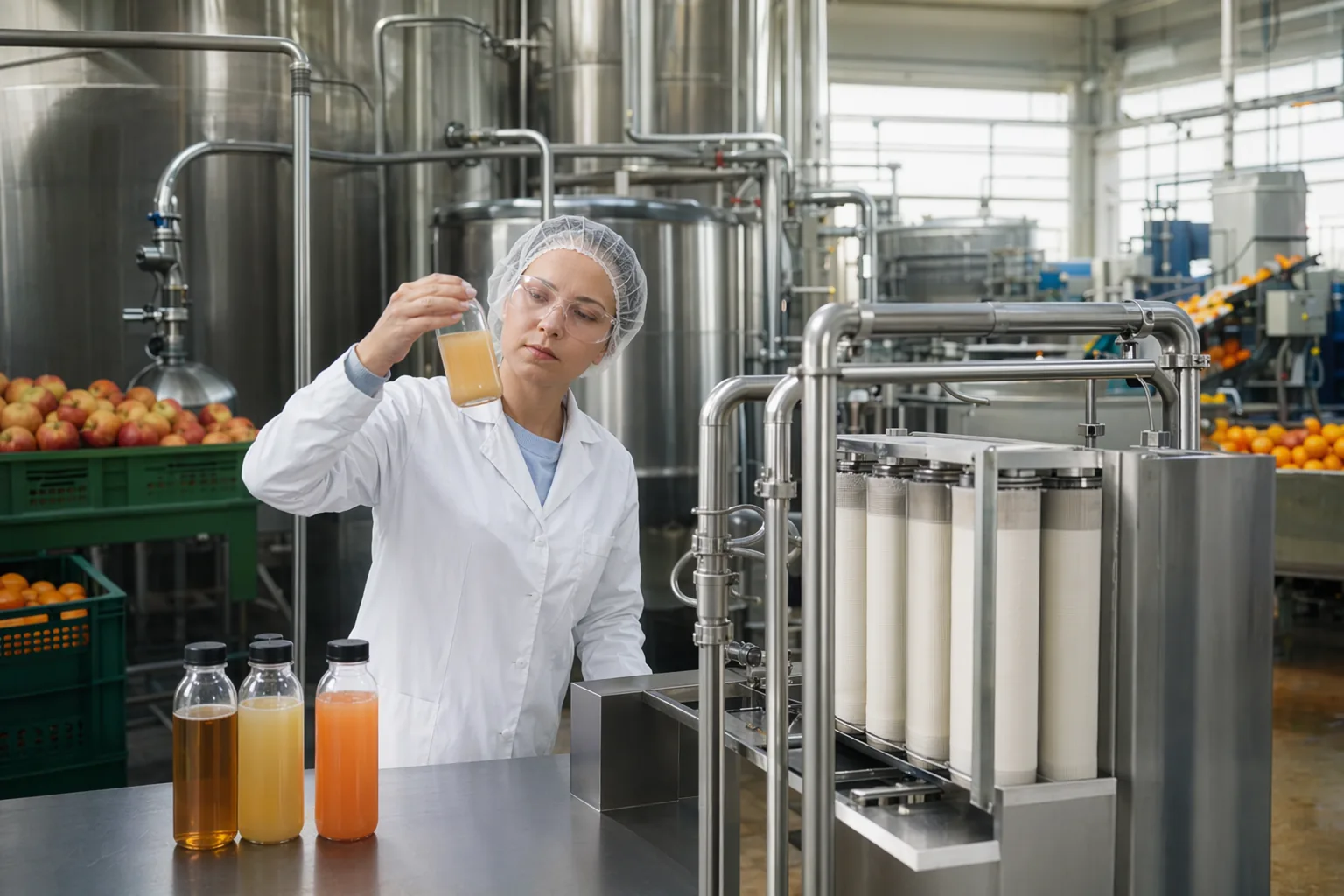
A practical B2B guide for processors evaluating pectinase-based clarification programs, pilot trials, QC checkpoints, and supplier documentation for stable, efficient juice production.
Why Enzymes Matter in Industrial Juice Clarification
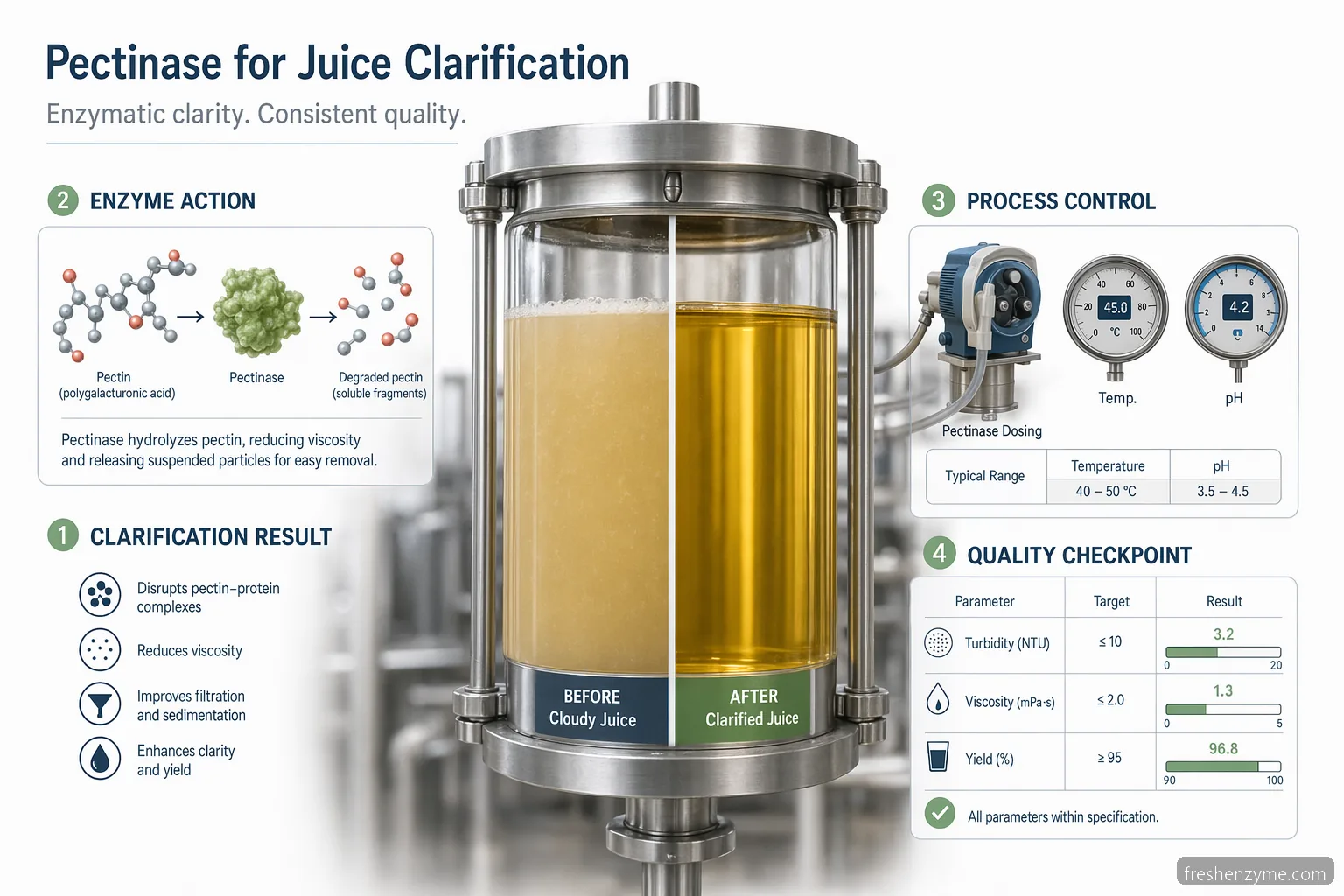
A juice clarification enzyme for juice clarification is typically a pectinase-rich preparation designed to break down soluble and colloidal pectin in fruit mash, pressed juice, or wine must. Pectin keeps suspended solids dispersed, increases viscosity, slows settling, and can blind filters or centrifuges. By hydrolyzing pectin structure, the enzyme helps release bound liquid, reduce haze potential, improve separation efficiency, and support more predictable polishing. For B2B processors, the goal is not simply a clearer appearance; it is stable throughput, lower filtration pressure, reduced rework, and consistent finished-product specifications. The right fruit enzyme program depends on apple, berry, citrus, grape, tropical fruit, or mixed-fruit matrix behavior. Raw-material maturity, heat history, soluble solids, and natural pectin variation all influence performance. Because these variables change by season, industrial users should treat enzyme selection as a process-control decision, supported by lab screening and production data.
Improves pectin breakdown and viscosity reduction • Supports settling, centrifugation, and filtration • Helps reduce haze risk in clarified juice and wine • Can improve process consistency across variable fruit lots
Typical Process Conditions and Dosing Window
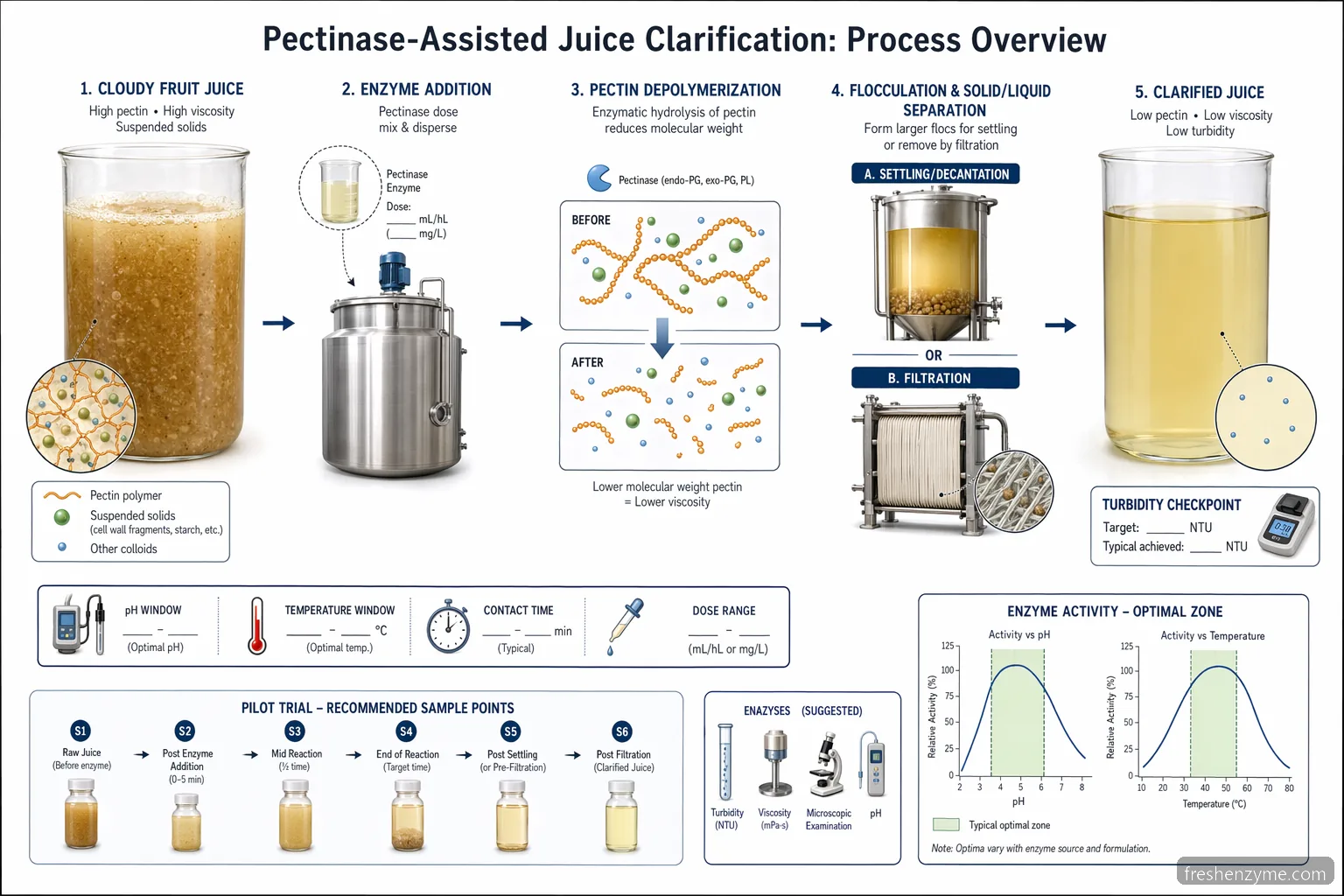
Most pectinase juice applications operate in the acidic range naturally found in fruit systems. A common starting range is pH 3.0 to 5.0, with many apple, grape, berry, and tropical juice processes working effectively near pH 3.2 to 4.5. Temperature is often set between 35°C and 55°C for mash treatment or juice clarification, depending on product quality targets, pasteurization sequence, and enzyme heat tolerance. Contact time may range from 30 minutes to 2 hours for liquid juice, and longer for difficult pulps or low-temperature processing. Typical trial dosages may start around 20 to 100 g per metric ton, or supplier-recommended liquid equivalents, then be optimized by pectin test, turbidity, viscosity, and filtration performance. Avoid excessive heat exposure before the intended reaction period, and verify whether the enzyme should be added before pressing, after pressing, or before fining.
Starting pH: commonly 3.0-5.0 • Typical temperature: 35-55°C, process dependent • Contact time: often 30-120 minutes • Trial dosage: commonly 20-100 g/MT or liquid equivalent • Optimize by substrate, enzyme activity, and equipment limits
Application Fit: Juice, Wine, and Fruit Processing
The same category of juice processing enzyme may be used differently across juice clarification, wine, and fruit processing lines. In pressed apple or pear juice, the priority is often rapid depectinization, press yield, lower filter load, and bright clarity. In grape must and wine, the focus may include settling speed, lees compaction, color management, and avoiding over-extraction from skins or seeds. For berry and tropical fruit processing, higher pulp content, anthocyanins, proteins, or starch-like haze contributors may require a blended enzyme approach or additional fining validation. Buyers searching for a juice clarification enzyme supplier for wine, a juice clarification enzyme supplier for juice clarification, or a juice clarification enzyme supplier for fruit processing should compare application data rather than only headline activity units. Industrial juice clarification enzyme wine and industrial juice clarification enzyme juice clarification programs should be evaluated under the same plant conditions used for commercial production.
Apple and pear: depectinization, yield, filtration • Grape and wine: settling, lees compaction, clarity • Berry: pulp handling and color-sensitive validation • Tropical fruit: viscosity reduction and separation support
Pilot Validation and Quality Control Checks
Pilot validation is essential before approving any juice clarification enzyme for wine, juice, or fruit processing. A practical test plan should compare untreated control, current enzyme, and proposed enzyme at multiple dosages using the same juice lot. Measure pH, Brix, temperature, treatment time, turbidity, viscosity, filterability, sediment volume, yield, and sensory attributes after clarification. A simple alcohol test, pectin test, or equivalent pectin residual method can confirm depectinization, while NTU readings show clarity progress. Filtration trials should record flow rate, pressure rise, filter aid consumption, membrane fouling, and cleaning impact. If the line includes fining agents, centrifugation, ultrafiltration, pasteurization, or concentration, include those steps in the pilot. Successful validation should define the dosage band, addition point, minimum contact time, hold temperature, and inactivation or downstream handling strategy for routine production.
Run untreated and incumbent-enzyme controls • Track NTU, viscosity, pectin residual, and yield • Confirm filtration rate and pressure behavior • Check sensory impact before commercial adoption • Document the approved operating window
Supplier Qualification and Cost-in-Use
For industrial procurement, enzyme price per kilogram is only one part of the decision. Cost-in-use should include dosage, yield improvement, clarification time, labor, filter media, energy, tank occupancy, rework, waste, and cleaning frequency. A lower-priced product may cost more if it requires higher dosage or slows filtration. During supplier qualification, request a current COA for representative lots, TDS with activity description and use guidance, SDS for safe handling, storage and shelf-life information, allergen or GMO statements where relevant, and traceability documentation. Ask how activity is standardized, how batch variation is controlled, and whether technical support is available for pilot and scale-up. Freshenzyme.com can support buyers comparing juice clarification enzyme, pectinase juice, fruit enzyme, and juice processing enzyme options by focusing on application fit, process validation, documentation, and reliable batch-to-batch supply rather than unsupported performance claims.
Evaluate delivered cost per treated ton • Include yield, filtration, labor, and downtime • Request COA, TDS, SDS, and traceability • Confirm storage, shelf life, and handling requirements • Qualify the supplier with pilot and production data
Technical Buying Checklist
Buyer Questions
A juice clarification enzyme is an industrial processing aid, commonly based on pectinase activity, used to break down pectin and related colloids in fruit juice, pulp, or wine must. By reducing viscosity and haze-forming material, it supports settling, centrifugation, filtration, and stable clarity. It should be selected according to fruit type, pH, temperature, dosage, processing sequence, and finished-product requirements.
Evaluate a supplier on application fit, technical support, lot documentation, batch consistency, and pilot validation, not only unit price. Request COA, TDS, SDS, storage guidance, shelf-life details, and traceability. A qualified juice clarification enzyme supplier for juice clarification should help define dosage trials, QC checks, cost-in-use, and scale-up parameters for your specific fruit matrix and equipment.
Sometimes, but it should be validated separately. A juice clarification enzyme for wine may need different handling because grape must, skin contact, phenolics, lees behavior, and sensory targets differ from apple or tropical juice. When comparing a juice clarification enzyme supplier for wine, ask for wine-specific application guidance and run bench trials for settling, clarity, color, aroma, and filtration impact.
A practical starting range for many pectinase-based powder products is about 20 to 100 g per metric ton, or the supplier-recommended liquid equivalent. Use at least three dosage levels plus an untreated control and, if possible, your current enzyme. Final dosage should be chosen from pectin residual, turbidity, viscosity, filtration rate, yield, sensory results, and total cost-in-use.
Use a combination of process and product tests. Common checks include pH, Brix, treatment temperature, contact time, pectin residual, NTU turbidity, viscosity, sediment volume, and filterability. For production approval, also monitor yield, filter pressure rise, flow rate, cleaning impact, and sensory attributes. The best QC plan links enzyme treatment results to your commercial clarity and throughput specifications.
Follow the supplier TDS and SDS. In general, keep enzyme products sealed, dry, and protected from excessive heat, moisture, and direct sunlight. Avoid dust generation for powders and use appropriate personal protective equipment based on the SDS. Confirm shelf life, activity retention, and recommended storage temperature with the supplier, then rotate inventory by lot to support consistent plant performance.
Related Search Themes
juice clarification enzyme, juice clarification enzyme supplier for wine, juice clarification enzyme supplier for juice clarification, juice clarification enzyme supplier for fruit processing, juice clarification enzyme for wine, juice clarification enzyme for fruit processing
Juice Clarification Enzymes for Research & Industry
Need Juice Clarification Enzymes for your lab or production process?
ISO 9001 certified · Food-grade & research-grade · Ships to 80+ countries
Frequently Asked Questions
What is a juice clarification enzyme?
A juice clarification enzyme is an industrial processing aid, commonly based on pectinase activity, used to break down pectin and related colloids in fruit juice, pulp, or wine must. By reducing viscosity and haze-forming material, it supports settling, centrifugation, filtration, and stable clarity. It should be selected according to fruit type, pH, temperature, dosage, processing sequence, and finished-product requirements.
How do I choose a juice clarification enzyme supplier for juice clarification?
Evaluate a supplier on application fit, technical support, lot documentation, batch consistency, and pilot validation, not only unit price. Request COA, TDS, SDS, storage guidance, shelf-life details, and traceability. A qualified juice clarification enzyme supplier for juice clarification should help define dosage trials, QC checks, cost-in-use, and scale-up parameters for your specific fruit matrix and equipment.
Can the same enzyme be used for wine and juice clarification?
Sometimes, but it should be validated separately. A juice clarification enzyme for wine may need different handling because grape must, skin contact, phenolics, lees behavior, and sensory targets differ from apple or tropical juice. When comparing a juice clarification enzyme supplier for wine, ask for wine-specific application guidance and run bench trials for settling, clarity, color, aroma, and filtration impact.
What dosage should we start with in pilot trials?
A practical starting range for many pectinase-based powder products is about 20 to 100 g per metric ton, or the supplier-recommended liquid equivalent. Use at least three dosage levels plus an untreated control and, if possible, your current enzyme. Final dosage should be chosen from pectin residual, turbidity, viscosity, filtration rate, yield, sensory results, and total cost-in-use.
Which QC checks confirm successful enzyme clarification?
Use a combination of process and product tests. Common checks include pH, Brix, treatment temperature, contact time, pectin residual, NTU turbidity, viscosity, sediment volume, and filterability. For production approval, also monitor yield, filter pressure rise, flow rate, cleaning impact, and sensory attributes. The best QC plan links enzyme treatment results to your commercial clarity and throughput specifications.
How should juice clarification enzymes be stored and handled?
Follow the supplier TDS and SDS. In general, keep enzyme products sealed, dry, and protected from excessive heat, moisture, and direct sunlight. Avoid dust generation for powders and use appropriate personal protective equipment based on the SDS. Confirm shelf life, activity retention, and recommended storage temperature with the supplier, then rotate inventory by lot to support consistent plant performance.
Related: Clearer Fruit Juices with Faster Separation
Turn This Guide Into a Supplier Brief Contact FreshEnzyme to discuss pilot samples, documentation, and cost-in-use validation for your juice clarification line. See our application page for Clearer Fruit Juices with Faster Separation at /applications/fruit-juice-clarification/ for specs, MOQ, and a free 50 g sample.
Contact Us to Contribute