Pectinase Juice Supplier for Juice Clarification
Source pectinase juice enzymes for clarification with dosing, pH, temperature, QC, COA/TDS/SDS, pilot validation, and supplier checks.
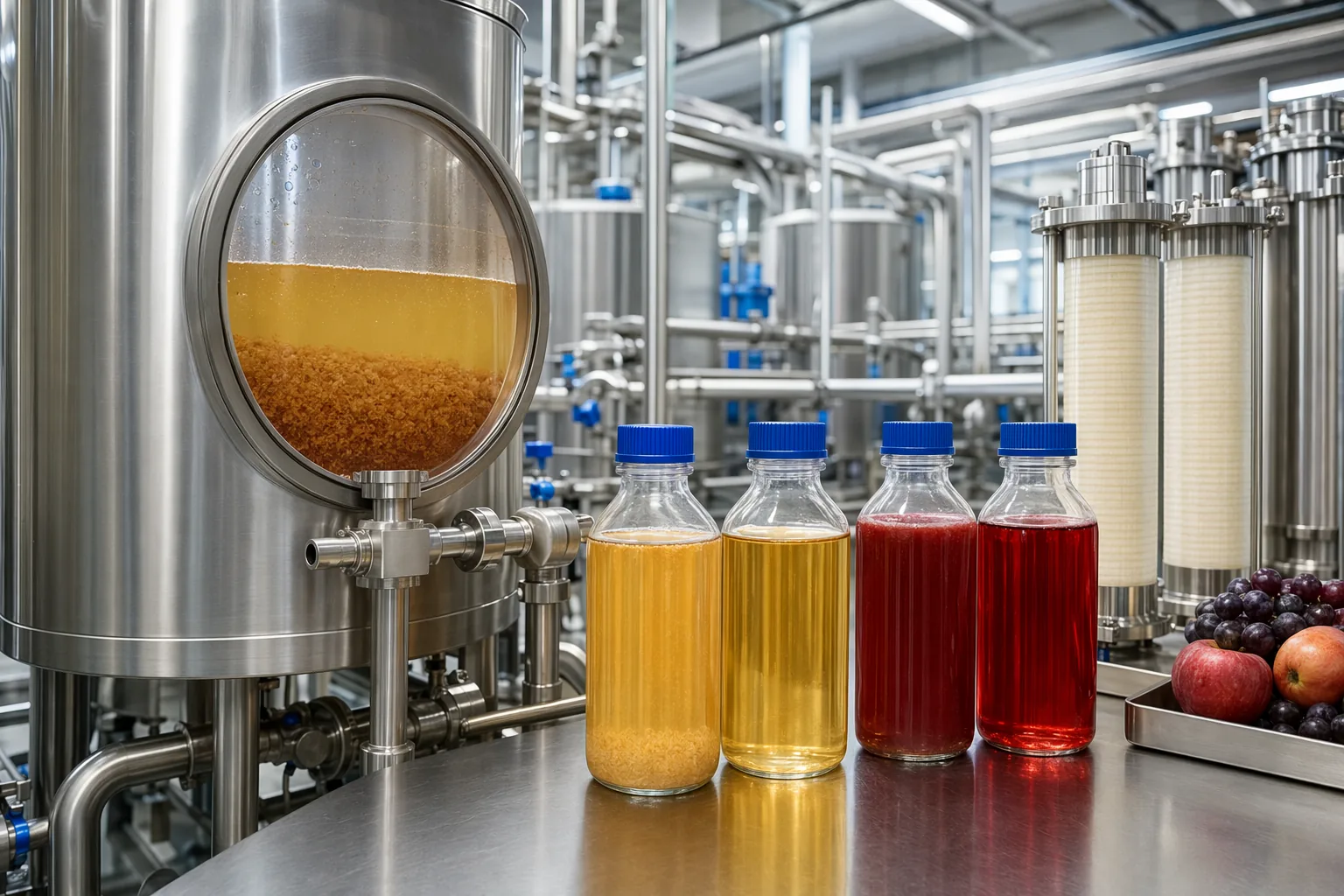
Select industrial juice clarification enzymes with the right activity profile, process fit, documentation, and cost-in-use for reliable beverage and fruit processing operations.
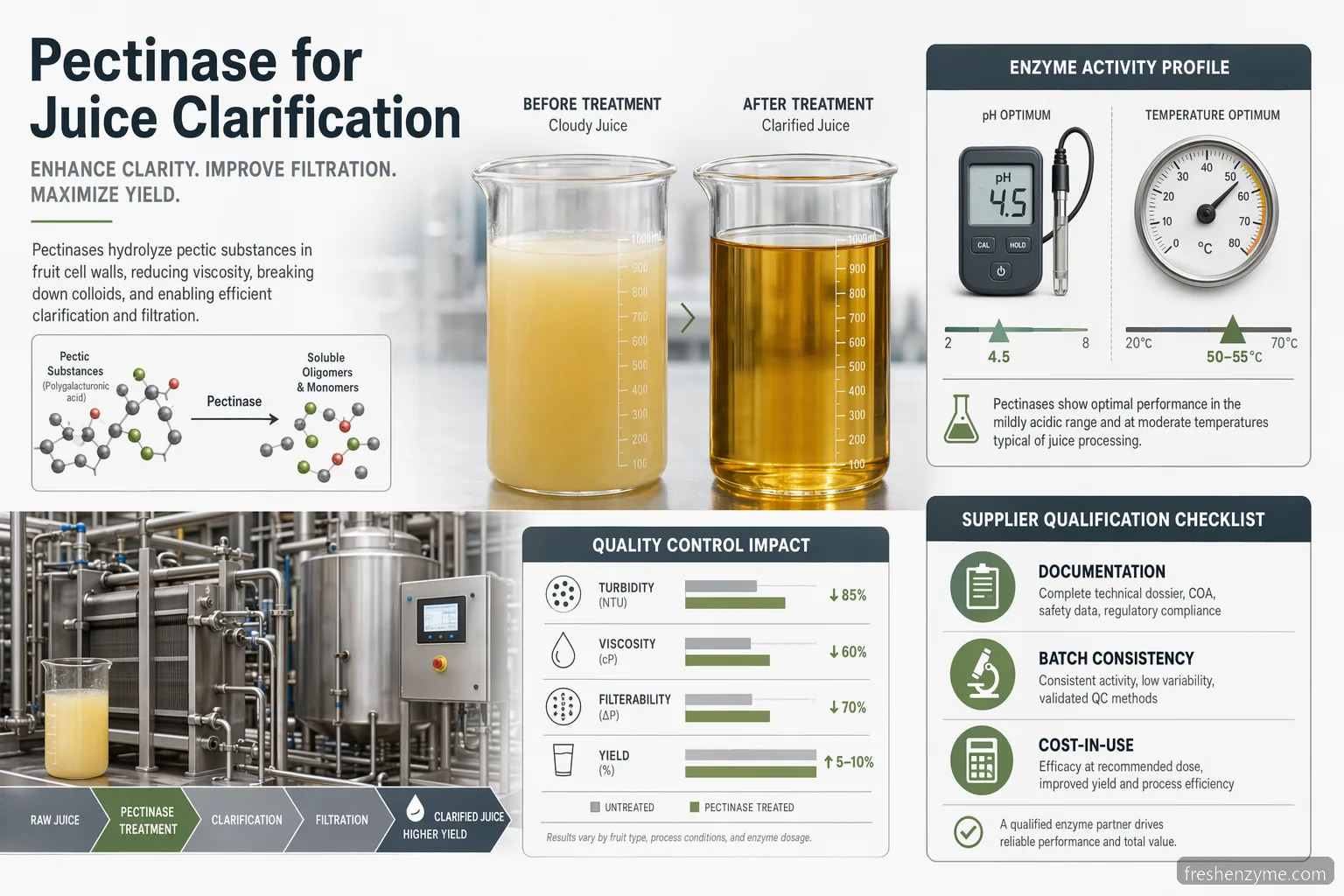
Industrial Enzyme Selection for Clear, Stable Juice
A reliable pectinase juice supplier for juice clarification should offer more than a catalog item. Industrial buyers need enzyme preparations matched to raw material, press conditions, clarification equipment, and final beverage targets. Pectinases break down pectin networks that hold suspended solids, increase mash viscosity, and slow separation. In apple, berry, tropical fruit, and blended juice lines, the right juice clarification enzyme can improve depectinization, settling, decanter performance, membrane flux, and polish filtration. Selection depends on fruit variety, maturity, pectin load, desired turbidity, residence time, and whether treatment is applied to mash, pressed juice, or concentrate rework. Fresh Enzyme supports B2B buyers comparing fruit enzyme options for juice clarification, wine, and fruit processing with practical process parameters, documentation review, and pilot-scale evaluation before commercial use.
Suitable for clarification-focused juice, wine, and fruit processing applications • Targets pectin-driven viscosity, haze, and slow filtration • Can be evaluated in mash treatment or post-press juice treatment • Best selected through controlled pilot trials, not dosage assumptions alone
Process Conditions to Validate Before Scale-Up
Pectinase performance is highly dependent on pH, temperature, holding time, and substrate load. Many fruit juice processes operate around pH 3.0-4.5, where acidic pectinases are commonly used, but each product should be checked against the supplier TDS. Typical trial temperatures may range from 35-55 C, balancing faster reaction rates with aroma retention and downstream pasteurization plans. A practical initial dosage screen may test 20-150 g per metric ton of juice or mash, adjusted for declared activity, raw material pectin content, and required throughput. Contact times often start at 30-120 minutes, followed by enzyme inactivation if the process includes heat treatment. Buyers should confirm that proposed conditions do not compromise color, flavor, or product specifications.
Run side-by-side controls without enzyme • Record pH, temperature, dosage, contact time, and mixing intensity • Check compatibility with fining agents, centrifuges, membranes, or filters • Confirm heat treatment or downstream conditions fit the enzyme plan
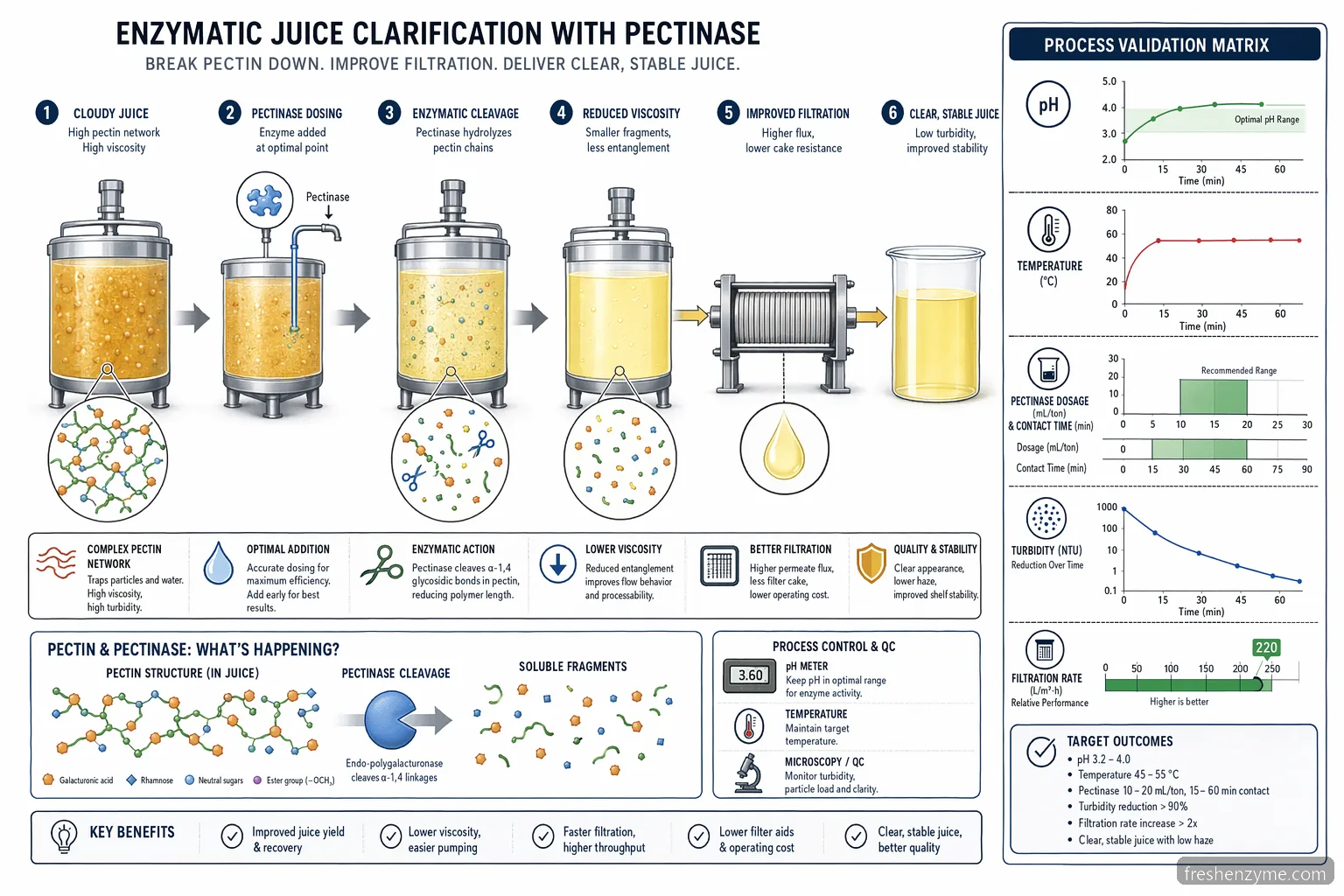
QC Metrics for Juice Clarification Trials
A juice clarification enzyme supplier for juice clarification should help define measurable success criteria before a plant trial. Common quality checks include viscosity reduction, pectin test results, turbidity or NTU, soluble solids, pH, color, sediment volume, filtration rate, membrane flux, and final yield. For wine and premium juice, sensory screening is also important to confirm that enzyme treatment does not create unwanted aroma changes or excessive extraction of phenolics. Industrial pectinase juice clarification trials should include untreated controls and, when possible, an incumbent enzyme benchmark. Data should be collected at laboratory, pilot, and production scales because mixing, heat transfer, and residence time can change the result. The best buying decision is based on reproducible clarification performance and total process economics.
Measure haze, turbidity, viscosity, and filtration time • Use alcohol-gel or equivalent pectin checks where applicable • Track juice yield and loss in pomace or sediment • Evaluate taste, color, and aroma against target specifications
Documentation and Supplier Qualification
For B2B procurement, supplier qualification should be as rigorous as the enzyme trial. Request a current COA for the lot offered, a TDS describing activity, recommended use range, storage, and handling, and an SDS for safety and workplace review. Buyers should also evaluate lot traceability, shelf-life policy, packaging integrity, allergen or processing-aid declarations where relevant, and change-notification practices. Avoid relying on unsupported claims or generic activity descriptions that do not connect to your fruit matrix. Whether you need a pectinase juice supplier for wine, a pectinase juice supplier for fruit processing, or a fruit enzyme supplier for juice clarification, the documentation package should support internal QA, purchasing, production, and regulatory review without adding unnecessary delays.
Request COA, TDS, SDS, and lot traceability information • Confirm recommended storage temperature and shelf life • Review packaging sizes for plant dosing and inventory control • Ask how specification changes and lot changes are communicated
Cost-in-Use: Look Beyond Price per Kilogram
The lowest enzyme price is not always the lowest process cost. Cost-in-use should include dosage, activity concentration, clarification time, juice yield, filtration throughput, labor, energy, waste handling, and the value of reduced bottlenecks. A higher-activity pectinase may cost more per kilogram but require less product, shorter holding time, or fewer filtration interruptions. Conversely, an inexpensive enzyme can be costly if it creates variable clarification or requires excessive residence time. Compare suppliers with the same trial design, the same raw material lot when possible, and the same acceptance criteria. A qualified juice clarification enzyme supplier for wine, juice clarification, and fruit processing should be able to support dosage optimization rather than pushing a single standard use rate.
Calculate enzyme cost per ton of juice or mash • Include filtration gains, yield gains, and reduced downtime • Compare equivalent activity and performance, not only package price • Assess supply reliability and lead time as part of the cost model
How Fresh Enzyme Supports Industrial Buyers
Fresh Enzyme helps processors evaluate pectinase juice for juice clarification with a practical, procurement-ready approach. Our team can discuss fruit type, process flow, target clarity, available holding time, operating pH and temperature, and downstream equipment before recommending a trial plan. We support buyers who search for industrial pectinase juice juice clarification solutions and need clear technical information for purchasing and plant validation. Pilot validation is encouraged before commercial adoption, especially for high-pectin fruit, seasonal raw material variation, or membrane-based clarification. We can provide product documentation for review and help structure a comparison against current processing conditions so your team can make a data-based supplier decision.
Application discussion before product selection • Pilot trial planning for juice, wine, and fruit processing lines • Documentation support for QA and purchasing teams • Focus on repeatable results and practical plant implementation
Technical Buying Checklist
Buyer Questions
Pectinase breaks down pectin structures that increase viscosity and keep fine fruit particles suspended. In juice clarification, this can improve settling, centrifugation, decanter performance, and filtration rate. The result depends on fruit type, pectin content, pH, temperature, contact time, and dosage. Buyers should confirm performance with controlled pilot testing before approving commercial use.
Choose a supplier that provides application guidance, COA, TDS, SDS, lot traceability, and clear storage instructions. The supplier should help design a trial using your fruit matrix, target clarity, equipment, and throughput needs. Compare cost-in-use, not just unit price, and verify that the enzyme delivers consistent viscosity reduction, pectin removal, filtration improvement, and sensory neutrality.
Some pectinase preparations may be suitable for both juice and wine clarification, but the fit must be validated. Wine applications can be more sensitive to phenolic extraction, aroma impact, color changes, and processing temperature. If you need a juice clarification enzyme supplier for wine, request application-specific guidance and test at the pH, temperature, and contact time used in your cellar.
A practical starting screen may evaluate about 20-150 g per metric ton of juice or mash, but dosage depends on enzyme activity, pectin load, fruit variety, processing temperature, and desired residence time. Always follow the supplier TDS and run pilot trials with controls. The optimized dosage is the lowest level that meets clarification, yield, filtration, and sensory targets.
Industrial buyers should request a COA for the offered lot, a TDS with activity and use guidance, an SDS for safe handling, and information on shelf life, storage, packaging, and traceability. For supplier qualification, also ask about change notification, batch consistency, technical support, and whether the supplier can support pilot validation before routine production purchasing.
Related Search Themes
pectinase juice supplier for wine, pectinase juice supplier for fruit processing, pectinase juice for juice clarification, juice clarification enzyme supplier for wine, juice clarification enzyme supplier for juice clarification, juice clarification enzyme supplier for fruit processing
Juice Clarification Enzymes for Research & Industry
Need Juice Clarification Enzymes for your lab or production process?
ISO 9001 certified · Food-grade & research-grade · Ships to 80+ countries
Frequently Asked Questions
What does pectinase do in juice clarification?
Pectinase breaks down pectin structures that increase viscosity and keep fine fruit particles suspended. In juice clarification, this can improve settling, centrifugation, decanter performance, and filtration rate. The result depends on fruit type, pectin content, pH, temperature, contact time, and dosage. Buyers should confirm performance with controlled pilot testing before approving commercial use.
How do I choose a pectinase juice supplier for fruit processing?
Choose a supplier that provides application guidance, COA, TDS, SDS, lot traceability, and clear storage instructions. The supplier should help design a trial using your fruit matrix, target clarity, equipment, and throughput needs. Compare cost-in-use, not just unit price, and verify that the enzyme delivers consistent viscosity reduction, pectin removal, filtration improvement, and sensory neutrality.
Can the same juice clarification enzyme be used for wine?
Some pectinase preparations may be suitable for both juice and wine clarification, but the fit must be validated. Wine applications can be more sensitive to phenolic extraction, aroma impact, color changes, and processing temperature. If you need a juice clarification enzyme supplier for wine, request application-specific guidance and test at the pH, temperature, and contact time used in your cellar.
What dosage should be used for pectinase juice clarification?
A practical starting screen may evaluate about 20-150 g per metric ton of juice or mash, but dosage depends on enzyme activity, pectin load, fruit variety, processing temperature, and desired residence time. Always follow the supplier TDS and run pilot trials with controls. The optimized dosage is the lowest level that meets clarification, yield, filtration, and sensory targets.
What documents should industrial enzyme buyers request?
Industrial buyers should request a COA for the offered lot, a TDS with activity and use guidance, an SDS for safe handling, and information on shelf life, storage, packaging, and traceability. For supplier qualification, also ask about change notification, batch consistency, technical support, and whether the supplier can support pilot validation before routine production purchasing.
Related: Clearer Fruit Juices with Faster Separation
Turn This Guide Into a Supplier Brief Contact Fresh Enzyme to discuss your juice clarification trial, documentation needs, and cost-in-use evaluation. See our application page for Clearer Fruit Juices with Faster Separation at /applications/fruit-juice-clarification/ for specs, MOQ, and a free 50 g sample.
Contact Us to Contribute